Where the Chapters Really Break
How the Hebrew manuscripts divide Scripture differently from your English and Tamil Bible
Part 1 of the series “Where the Chapters Really Break” ·
Ask a seminary student to open Leviticus 6:1, and he will read a law about deceiving one’s neighbour in a matter of a deposit or a robbery. Ask a rabbi in Jerusalem to open the same reference, and he will read the command to Aaron concerning the burnt offering that must remain on the altar hearth all night.
Both are reading the sixth chapter of Leviticus. Neither is misquoting. The two Bibles simply do not divide the book in the same place and most students of Scripture in India, including many who teach it, have never been told.
This is not a cataloguing curiosity. Chapter and verse boundaries shape how we read. They suggest where a unit of thought begins and ends, they govern how cross references are built, and they silently encode editorial decisions made centuries after the biblical authors wrote. When an English or Tamil Bible differs from the Hebrew manuscripts in its numbering and it does so in more than a dozen books of the Old Testament the reader inherits a medieval Latin framework laid over a Jewish text, and is never informed of the substitution.
Consider Isaiah’s fourth Servant Song or Suffering Servant. In Hebrew, in English, and in Tamil alike, it runs from 52:13 to 53:12 one unbroken poem. Yet the chapter line falls squarely inside it, three verses before the close of chapter 52, so that the passage the church knows as “Isaiah 53” actually opens mid song, its first word cut from the summons that introduces it: Behold, my servant shall act wisely (52:13). Here the numbering is not in dispute; Hebrew, English, and Tamil count these verses identically. The fracture is purely a matter of where a thirteenth century editor chose to draw his line and it teaches the first lesson plainly: the chapter is a frame laid over the text, not a seam within it, and the frame does not always honour the shape of what it holds.
But the difficulty runs deeper than a clumsy break. Elsewhere the frame itself shifts and the same reference lands on different words in the Hebrew than it does in your Bible.
This article traces where the divisions came from, sorts the differences into their proper classes, examines two representative cases in detail, and asks how the Tamil translation tradition has handled the problem. Every claim can be checked against the manuscript text on this site.
1. What the manuscripts actually contain
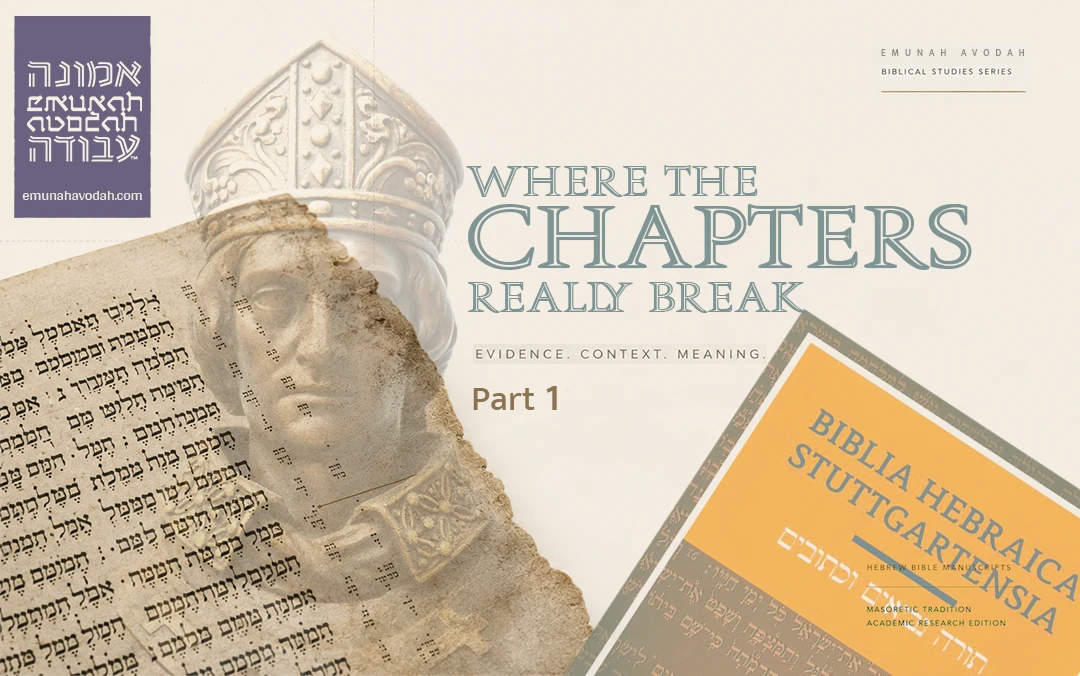
The oldest complete Hebrew Bible in existence is the Leningrad Codex (AD 1008), the manuscript underlying both the Biblia Hebraica Stuttgartensia (BHS) and the Westminster Leningrad Codex and the text verified across every Hebrew chapter on this platform. It contains no chapter numbers at all.
What it contains instead is an older, native Jewish system of division:
Pesuqim / פְּסוּקִים (verses). Verse division is genuinely ancient. Each verse closes with the sof pasuq (׃) / סוֹף פָּסוּק, and the Masoretes counted the verses of every book with obsessive precision, recording totals and midpoints in the Masorah. The verse, as a unit, is Jewish and pre medieval.
Petuchah / פְּתוּחָה, and setumah / סְתוּמָה (open and closed paragraphs). Spacing breaks in the manuscript a new line for a major break (פ), a gap within the line for a minor one (ס) mark the sense units the scribes themselves recognised. These are the Hebrew Bible’s native paragraphing.
Sedarim / סְדָרִים and parashot. Liturgical divisions for the reading cycles: the sedarim of the triennial cycle, and the 54 parashot of the annual Torah cycle still read in synagogues every Sabbath.
Chapters, by contrast, are a Christian medieval invention. The chapter system in every printed Bible today Hebrew, English, or Tamil descends from divisions imposed on the Latin Vulgate around AD 1205 by Stephen Langton, later Archbishop of Canterbury, for the convenience of the Paris schools. Printed verse numbers came later still: Rabbi Isaac Nathan’s concordance (c. 1440) numbered the Hebrew Bible using Langton’s chapters, and Robert Estienne’s editions of the 1550s fixed the numbering for the Christian West.
Then comes the crucial turn. When Jewish printers beginning with the Bomberg Rabbinic Bibles of the 1510s–20s adopted Langton’s chapters for reference convenience, they kept the Masoretic verse divisions intact. They would not let a Latin system override where a Hebrew verse actually ends, and in a number of places they set the chapter break where the Masoretic paragraphing demanded rather than where Langton had put it.
The result: the printed Hebrew Bible and the printed Christian Bible run on two slightly different grids. Wherever the grids disagree, every English translation follows the Latin grid, and the Hebrew Bible follows its own.
2. The three kinds of difference
We should learn to distinguish these, because they have entirely different causes and conflating them is exactly the imprecision careful training should eliminate.
2.1 Chapter boundary shifts
Same text, same verses, different placement of the break.
| Hebrew (MT) | English & Tamil tradition | Nature of the shift |
| Gen 32:1 | Gen 31:55 | Hebrew begins ch. 32 one verse earlier |
| Lev 5:20–26 | Lev 6:1–7 | English ch. 6 opens with material Hebrew keeps in ch. 5 |
| Deut 13:1 | Deut 12:32 | One verse shift |
| 1 Sam 21:1 | 1 Sam 20:42b | One verse shift |
| 1 Kgs 5:1–14 | 1 Kgs 4:21–34 | Fourteen verse displacement |
| Isa 8:23 | Isa 9:1 | “Galilee of the nations” |
| Jer 8:23 | Jer 9:1 | “O that my head were waters…” |
| Ezek 21:1 | Ezek 20:45 | Five verse shift |
| Dan 3:31–33 | Dan 4:1–3 | Nebuchadnezzar’s doxology |
| Hos 2:1–2 | Hos 1:10–11 | “Sons of the living God” |
| Joel 3:1–5; 4:1–21 | Joel 2:28–32; 3:1–21 | Hebrew Joel has four chapters; English has three |
| Jonah 2:1 | Jonah 1:17 | The great fish |
| Mic 4:14 | Mic 5:1 | “Smite the judge of Israel” |
| Nah 2:1 | Nah 1:15 | “Feet of him who brings good news” |
| Zech 2:1–4 | Zech 1:18–21 | Hebrew Zech 2 has 17 verses; English 13 |
| Mal 3:19–24 | Mal 4:1–6 | Hebrew Malachi has no chapter 4 at all |
| Neh 3:33–38 | Neh 4:1–6 | Sanballat’s mockery |
| 2 Chr 1:18 | 2 Chr 2:1 | One verse shift |
Several are theologically weighted. The English break at Joel 2:28 detaches the outpouring of the Spirit the text Peter preaches at Pentecost from the locust and repentance unit the Hebrew keeps it inside. The English Malachi 4 manufactures a dramatic closing chapter that in the Hebrew Bible is simply the end of chapter 3.
2.2 Superscriptions counted as verses: the Psalms
In the Hebrew Psalter the superscription “A Psalm of David, when he fled from Absalom his son” is verse 1, and in some psalms verses 1–2. The English tradition prints superscriptions as unnumbered headings.
The consequence: in roughly 116 psalms every English verse number runs one (sometimes two) behind the Hebrew. Psalm 51:1 in your Bible “Have mercy upon me, O God” is Psalm 51:3 in the Hebrew. Every concordance search, every commentary reference, every sermon citation crossing between Hebrew and translation must reckon with this offset, psalm by psalm.
2.3 Genuine textual absence
Sometimes a verse printed in your Bible is absent from the Hebrew manuscript itself. This is categorically different from a numbering dispute, and Nehemiah 7:68 is the showcase case.
3. Case study: Leviticus 5–6
In every English and Tamil Protestant Bible, Leviticus 6:1–7 carries the law of the ʾasham the guilt offering for sins against a neighbour: deposits, robbery, extortion, false oaths closing with the priest making atonement. Then 6:8 begins: “The LORD spoke to Moses, saying: Command (צַו) Aaron and his sons…”
The Hebrew Bible draws the line where the manuscript’s own structure draws it. Leviticus 5:20–26 (MT) is the neighbour ʾasham law, closing chapter 5’s sequence of guilt offering legislation. Hebrew Leviticus 6:1 opens with a fresh divine speech formula and a fresh addressee Aaron and the priests, not the laity.
This is not arbitrary. The Hebrew chapter break coincides with the opening of Parashat Tsav, the weekly Torah portion. The Jewish liturgical tradition, the Masoretic paragraphing, and the printed Hebrew chapter division all agree on where the seam lies. Langton’s division followed by every English translation since Wycliffe, and by every Tamil Bible after them cuts seven verses too early and welds the tail of the lay legislation onto the head of the priestly manual.
The arithmetic:
| English / Tamil | Hebrew (MT) |
| Lev 6:1–7 | Lev 5:20–26 |
| Lev 6:8–30 | Lev 6:1–23 |
MT Leviticus 5 has 26 verses (English: 19). MT Leviticus 6 has 23 (English: 30). A student who reads a BHS apparatus note “on Lev 6:2” and turns to English 6:2 is reading the wrong verse entirely.
See it for yourself: Table in 3.
4. Case study: Nehemiah 7:68 the verse the oldest manuscript does not have
English Nehemiah 7:68 reads: “Their horses were 736, their mules 245.”
Open the Leningrad Codex or the Westminster text, or the main text of BHS and the verse is not there. Hebrew verse 68 is the camels (435) and donkeys (6,720). The Hebrew chapter runs 72 verses against the English 73, and everything from English 7:69 onward sits one verse lower.
What happened? Almost certainly haplography: the census lines are visually near identical in Hebrew, and the scribe’s eye skipped from one to the next, dropping the horses and mules entry. We can say this with confidence because Nehemiah 7 is a doublet of Ezra 2 and Ezra 2:66, in the very same Leningrad Codex, contains the verse. Many other Masoretic manuscripts of Nehemiah contain it too, which is why BHS records it in the critical apparatus and why the English tradition, from the KJV onward, prints it.
| English / Tamil | Hebrew (MT) |
| Neh 7:1–67 | Neh 7:1–67 |
| Neh 7:68 (horses, mules) | absent from the Leningrad Codex |
| Neh 7:69–73 | Neh 7:68–72 |
The lesson is twofold. First, the printed Hebrew Bible is a diplomatic edition of a single manuscript it reproduces the Leningrad Codex faithfully, omission and all, and confines corrections to the apparatus. Your English Bible is an eclectic, translated edition it repairs the omission from the wider manuscript tradition without telling you it has done so.
Second, verse number divergence is a symptom demanding diagnosis. Leviticus 6 and Nehemiah 7 look alike on the surface “the numbers don’t match” but one is an editorial boundary dispute and the other is a genuine text critical event. Only the apparatus, never the translation, will tell you which.
See it for yourself: Table in 4.
5. The Tamil situation
The Tamil Bible tradition is among the oldest in Asia Ziegenbalg’s New Testament of 1714 predates most European vernacular missionary translations. Yet on this question it has been almost entirely a passive recipient of English decisions.
The Old Version (TOV) stands squarely in the KJV lineage, and its chapter and verse grid is the English grid, inherited wholesale. Tamil readers of the OV read Leviticus 6:1–7 as the neighbour ʾasham, a Malachi with four chapters, Psalms with unnumbered superscriptions, and a Nehemiah 7 of 73 verses every Latin tradition decision reproduced in Tamil, with no marginal note anywhere alerting the reader that the Hebrew differs. The versification was not chosen; it was absorbed, because the translation was made in conversation with the English Bible even where the originals were consulted.
Tiruviviliam (TVV), the interconfessional translation of the Bible Society of India and the TNBCLC, belongs to a different ecclesial stream it carries the deuterocanon and even its own Tamil book-names (Leviticus is *Leviyar*, Malachi *Malaakki*). One might expect its numbering to lean toward the Hebrew. It does not. Checked at the very points where the Hebrew and the English grid part company, TVV sits squarely on the English grid: Leviticus 6 opens with the neighbour-*ʾasham* (6:1–7), not the priestly burnt offering; Malachi runs to four chapters and Joel to three; and in Psalm 51 the superscription is an unnumbered heading, so *”O God, have mercy”* is verse 1, not verse 3. On versification, TVV is the Old Version’s twin.
The consequence is not two Tamil grids in conflict — it is one grid, uniformly inherited. From the Protestant OV to the Catholic-ecumenical TVV, across the whole denominational range, the Tamil-reading church numbers its Bible by Langton’s Latin frame, and not one of its major versions shows the reader where the Hebrew actually breaks. The divergence that matters is not between the two Tamil Bibles; it is between both of them and the manuscripts they descend from — which is exactly why it goes unnoticed.
This is the deeper point about research method. The problem is not that Indian seminaries lack access to BHS. The problem is a habit of treating the English Bible as the de facto original, so that the questions “where does the Hebrew chapter break?” and “is this verse in the manuscript?” never arise at all. A curriculum that required students to read even one chapter against a Leningrad Codex facsimile, petuchot and setumot visible on the page, would dismantle the assumption in a single afternoon.
6. What faithful handling looks like
For translators, publishers, and builders of digital Scripture platforms, these divergences demand explicit engineering, not silence:
- A complete alignment table between Masoretic and translation versification for every affected locus treated as canonical data, not patched ad hoc.
- Dual numbering in display wherever the grids diverge. The convention 6:1 [5:20 MT] costs nothing and teaches continuously.
- Categorical honesty boundary shifts, superscription offsets, and genuine textual absences marked differently, because they are different things.
- Teaching the native divisions sof pasuq, petuchah and setumah, sedarim and parashot belong in first year Old Testament introduction, before Langton’s chapters are ever mentioned.
Conclusion
Every chapter number in every Bible on earth is an act of interpretation performed centuries after the text was written. In the Old Testament, the interpretation printed in English and Tamil Bibles is frequently not the one carried by the Hebrew manuscripts themselves.
The Masoretes counted every verse of Scripture and recorded the count lest a single one be lost. The least their heirs in translation can do is tell the reader where the seams truly lie. For the Indian church whose access to Scripture is overwhelmingly mediated through translations of translations of editorial traditions recovering this knowledge is not academic vanity. It is a matter of handling the word of truth rightly, down to the boundaries of its chapters and the count of its verses.